I am back from Arizona. It was such a huge thing for me, and really gave me the taste for birding travel. I want to go everywhere. Mexico is really high on my list now. So is Florida. Weirdly, New Jersey has a lot of great birding, especially the Cape May area.
Here's the final numbers on the AZ trip:
I've been birding for around six months. In the state of Washington (where I live) I've seen 82 species total. In ten days in Arizona I saw 75 species, nearly catching me up with my home state! As far as new birds, I saw 49 species I'd never seen before, meaning my life list started at 91 before the trip and is now at 140.
Monday was my first attempt that what birders call a Big Day. There are Big Months and Big Weeks and the famous Big Year (they made a Jack Black/Owen Wilson/Steve Martin movie about that, though the free youtube movie Listers is probably my favorite film depiction of Big Year mania, alongside Kenn Kaufman's memoir Kingbird Highway about doing a big year via hitchhiking in the 70s). Basically the idea is that in addition to your life list -- a list of all the birds you've seen in your life -- you can do a day list or a week list or a month list -- a list of all the birds you've seen in a day or a week or a month. This means you start over and start writing down stuff like rock pigeons and robins and crows and you try to get as many species as possible before the day ends.
Now, my big day was a pretty pathetic one by seasoned birder standards at 31 species, but for someone who's been doing this for six months and isn't guided by a professional and is doing it in a city she doesn't know well and is travelling via public transit? I think it's pretty alright! Also I couldn't bird after dark because I am clueless about owling and because I got sleepy and had a flight the next day, not to mention dinner plans with an internet friend.
ANYWAY, on to the birds:
I started out my day in my aunt's neighborhood, just scoping things out on the way to and at the bus stop. Mostly expected birds here, which in AZ means Mourning Doves and House Sparrows. But I also got four White-Crowned Sparrows and a Western Meadowlark! That last one is an actual life bird for me just hanging out on a suburban tree. How cool. Here's a picture of a house sparrow for your records:

Then it was onto the main event: Moon Valley Park. Moon Valley Park doesn't look like much. There's a section of it that's mostly homeless camping. It's kinda scrubby and also green, but not green in like an impressive way (no offense AZ, you're beautiful but you can't do green like Washington). But for some reason it's got more birds and more types of birds than just about any city park I've been to. Here's a list of birds I saw in Moon Valley Park (asterisks are life birds):
Mallard Eurasian Collared-Dove Mourning Dove Anna's Hummingbird Red-tailed Hawk Gila Woodpecker Ladder-backed Woodpecker American Kestrel Say's Phoebe Woodhouse's Scrub-Jay Verdin Ruby-crowned Kinglet European Starling Curve-billed Thrasher Northern Mockingbird Phainopepla House Sparrow House Finch White-crowned Sparrow Abert's Towhee Yellow-rumped Warbler
Pretty cool!! Here's a photo of a Phainopepla, one of my the birds I've been talking about how I wanted to see really badly ever since I first planned this trip:
 The Phainopepla looks like a Jay, but it's not! Jays are a member of the corvid family, like Crows or Ravens, but this fellow is actually a member of a family called Silky Flycatchers, and he's one of the more northern examples, as most are in South and Central America.
Here's a Kestrel, followed by TWO Kestrels!


This is what a Ladder-Backed Woodpecker looks like:


And my buddy the Curve-Billed Thrasher, another I was reaaally hoping to see:
 It's an awkward angle here, but this guy is butt first if that helps you make sense of it. These guys make an amazing noise. It's like one of those toy laser guns for little kids that cycles through about six different laser sounds and then repeats? Listen.
Okay. Verdins. I spent most of my day at Moon Valley Park--and even at the BUS STOP before I got to the park--getting stuck in vegetation trying to hunt down the sound of one of these little guys. I was pulling leaves and needles out of my hair for a day afterward. I could hear them EVERYWHERE but I couldn't see one for the life of me. I BARELY got a glimpse at Moon Valley Park and counted it because I knew which bird it was for sure, even if I didn't see it super well. Then, when I get to my last birding stop of the day, I get this perfect photo of one performing for me.
 It's one of the best photos of a bird I've taken. I was ready to write off Verdins altogether because I was feeling so cranky every time I heard one. I was like "Look whatever it's like a Bushtit but with a yellow face, who cares" but if I was really honest with myself, I cared. Then there it was! Sometimes birding is high effort and sometimes it's as easy as laughing. You just can't ever know which it will be and have to be prepared for both. I took this photo in the parking lot of the Phoenix Desert Botanical Garden. Which was, by the way, my next stop!
Phoenix Desert Botanical Gardens costs $35 to enter, and there was no way I was going to pay that when I'd been gutted right and left paying for rental cards and greyhounds and whatnot all trip. Just not worth it. So what's a girl to do? I birded their parking lot. Take that PDBG. Their parking lot, by the way, is surrounded by beautiful desert foliage, plenty of room to house birds such as:
- Gambel's Quails, of which I saw two. What a wonderful, goofy bird. Rock Pigeons, Mourning Doves, Great-Tailed Grackles, European Starlings, House Finches, and Anna's Hummingbirds, all in great numbers.
- A Gila Woodpecker, my first of the day.
- A Costa's Hummingbird, my first ever in my life, he was very beautiful and his bill was a little droopy as Costa's are. This is only the third variety of hummingbird I've ever seen, as the PNW is lousy with Anna's and little else.
- A Gilded Flicker, which looks a lot like a Northern Flicker (a common bird in my backyard), but has the brown and grey swapped.*
- The aforementioned Verdin
- Some cute Ruby-crowned Kinglets
- And a few Abert's Towhees, a southwestern variety of the delightful Spotted Towhees that frequent my feeder
From there I went to Mill St in Tempe, where I planned to meet up with a long-distance friend: the composer Alex Temple, who you should check out! She does amazing experimental sound work. But did that mean I would stop birding? Hell no.
ON THE LITERAL BUS ON THE WAY THERE I GOT MORE BIRDS, including a life bird! I was birding on the bus! It helps that the bus was heading by Papago Park pond, which I should have just gotten out and birded at, as I didn't have any water birds yet, but I was nervous about things getting too late.
Here's what I caught in about 90 seconds of the bus sitting there: 3 American Coots, 3 Ring-Necked Ducks and a Neotropic Cormorant.
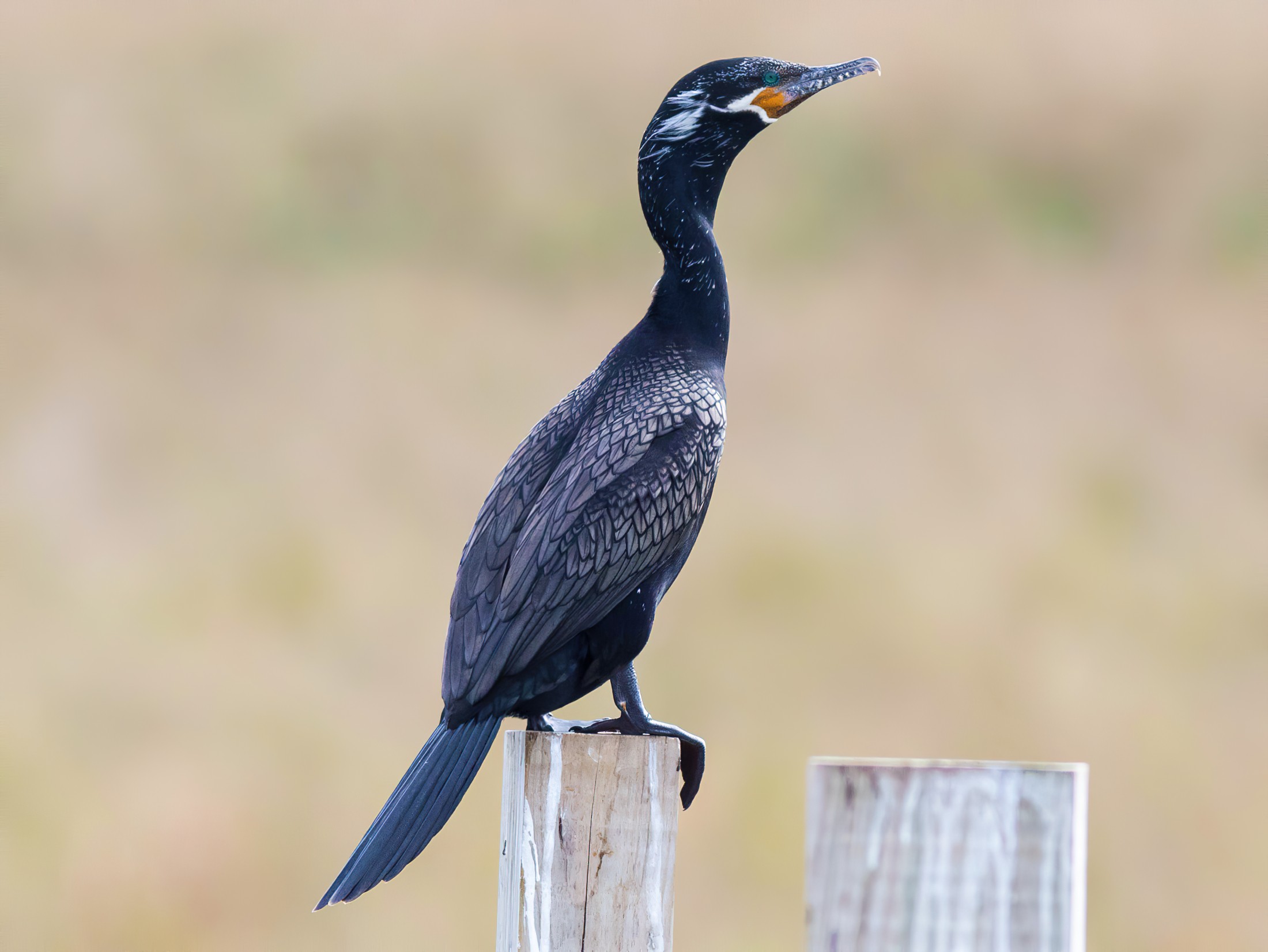
The Neotropic Cormorant is a more southern variety of Cormorant than the ones we have in the PNW, which are the Double-Crested Cormorant and the Pelagic Cormorant. They all look pretty similar, but you can usually figure them out by the mouth color business they got going on. The Neotropic was one I was on the lookout for, since I knew they showed up in AZ, and are actually as common as Double-Cresteds in Phoenix.
When I got to Tempe I birded around, but it was mostly city birds, southwestern-style: Rock Pigeons, Mourning Doves, European Starlings, Great-Tailed Grackles. What I was shocked to see, was that the tall palm trees lining the street were apparently also the home to three different Acorn Woodpeckers I found perched way up their trunks. I didn't get a good photo of the birds, but here's the same trees in beautiful downtown Tempe:

And that was my big day! All in all I saw 31 species in one day, which I think is pretty incredible. Phoenix is a great spot for birding and I really enjoyed myself. I think for my next big day I'd like to do one in Washington in the spring when things are really going off here and I have a car and know the best spots to hit.
Thanks for tuning in! Sara
*Unless you're comparing it to the actual Flicker in my yard, which is the Red-Shafted Northern Flicker, then it's the same but with yellow feathers underneath, but I'm talking about it compared to the eastern variety of flicker, the Yellow-Shafted Northern Flicker, which has the yellow feathers but the opposite head coloring more like the red-shafted blah blah blah blah.